Poster - Finite Element Method Plasma Simulation of Ceramic Metal Halide Lamps
Sep 24, 2014
·
0 min read
Abstract
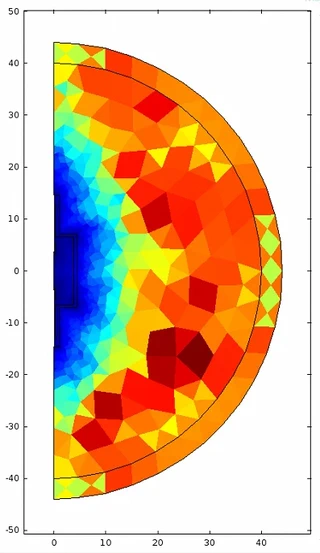
The ceramic metal halide lamps belong to the most efficient high intensity light sources of these days. Presently it is the nitrogen contamination that causes the most significant problems during ignition. If this material gets into the lamp’s interior in high concentrations, it will make the lamp unable to ignite properly at lower voltages. A self-consistent fluid model was developed in COMSOL Multiphysics® Plasma Module for studying the discharge phenomena. The results show that the nitrogen dissociation reaction affects the electrons’ kinetic energy distribution mainly by electron energy dissipation. The critical nitrogen concentration is around 500 ppm. Higher concentrations create significant change in breakdown process. In this case the breakdown voltage has to be increased in order to achieve ignition.
Date
Sep 24, 2014 1:00 PM — 2:00 PM
Location
University of Cambridge
The Old Schools, Cambridge, CB2 1TN

Authors
Quantitative Researcher
I am a PhD researcher in Mathematics with experience in stochastic modeling, probabilistic analysis, and large-scale simulation, supported by Python/C++ model development.
Previously, I worked as a machine learning researcher at Bosch, where I developed and validated predictive models with a focus on uncertainty estimation and data-driven decision-making.
I am interested in applying quantitative methods to forecasting and risk modeling in energy and financial markets.